"We're an AI-based company." In 2026, that sentence has roughly the same information content as "we use electricity." Almost everyone says it, investors have stopped being impressed by it, and — most importantly — almost nobody agrees on what it actually means.
Here's the uncomfortable truth: wiring an LLM API into your product is the easy part. Any competent engineer can do it in an afternoon. The demo looks magical, the board claps, and the "AI" bullet lands on the roadmap. Doing it without torching your budget on tokens, and without getting stuck in endless loops of development that never quite ship — that is the real story. And it's the thing that will separate you from everyone else claiming the same label.
So before you push AI into one more feature, it's worth stopping to examine the strategy. I see too many teams that connect the API — technically, everything is great — only to discover two months later that they're stuck with a bloated cloud bill (the CFO usually finds it first), an unstable user experience, and a product that doesn't actually deliver measurable, obvious value.
The Gap Nobody Puts in the Deck
"AI-based" describes a capability. It says nothing about whether that capability is economical, reliable, or even necessary. A recent MIT report on enterprise GenAI found that roughly 95% of pilots delivered no measurable P&L impact — not because the models were weak, but because the deployments were careless. Being an "AI company" and being a profitable AI company are two entirely different claims.
What "AI-Based" Really Buys You — And What It Costs
Every architecture is a set of trade-offs. When you make an LLM the beating heart of a feature, you're not just adding a capability — you're signing up for a very specific bundle of compromises. It helps to name them out loud, because the pitch deck never does:
- Determinism → Probability. Traditional code returns the same answer every time. An LLM returns a plausible answer, which is not the same thing. You trade "correct" for "usually correct, phrased beautifully."
- Fixed cost → Variable cost. A regex costs the same whether you run it once or a billion times. Every LLM call is metered. Your cost of goods sold is now coupled to usage in a way it never was before.
- Predictable latency → Tail latency. A database lookup is milliseconds. A flagship model under load can take seconds, and the slow requests are exactly the ones your most engaged users trigger.
- Debuggable → Opaque. When a rules engine misfires, you read the rule. When a model misfires, you're reverse-engineering a black box through prompt archaeology.
None of these are reasons to avoid AI. They're reasons to deploy it deliberately — with your eyes open to what you're giving up. The teams that win aren't the ones who use the most AI. They're the ones who know exactly which trade-offs they signed up for, and only sign up where the exchange is worth it.
Three Questions to Ask Before You Ship
Instead of discovering these trade-offs the hard, expensive way, ask yourself three questions. If you can't answer all three cleanly, your architecture has a hole in it that the cloud bill will eventually find.
1. What Is the ROI of Each Action?
This is the question that breaks most AI features. Not "does it work?" but "does the value this action creates for the customer, right now, exceed the cost of producing it?" If the processing cost is higher than the business value at that moment in time, your architecture is broken — no matter how impressive the demo was.
Companies that actually understand this have stopped measuring vanity metrics like raw user counts. Instead they track the numbers that tie AI spend to the bottom line:
The Metrics That Actually Matter
RoTS — Return on Token Spend
For every dollar of tokens you burn, how much value comes back? The AI-native equivalent of ROAS. If you can't express it, you're flying blind.
CPST — Cost Per Successful Task
Not cost per call — cost per completed, correct outcome. This is the number that quietly eats your margin, because it includes every retry, every failed generation, and every regenerate button an unhappy user mashes.
TVM — Token Value Margin
The gross margin left after inference cost. If serving each customer costs more in tokens than they pay you, you don't have a business — you have a very expensive science project subsidized by your runway.
A Worked Example
A SaaS team ships an "AI summary" button on every record. It feels premium, so it goes to the flagship model:
- • Cost per click: ~$0.04 in tokens (long record context + generous output)
- • Clicks per active user/month: ~120
- • Token cost per user/month: ~$4.80
- • Their plan price: $12/month
That single button consumes 40% of the plan's revenue before you've paid for hosting, support, or salaries. Nobody modeled the CPST before shipping. The feature demos beautifully and destroys the unit economics — the definition of a broken architecture.
2. Do You Actually Need AI Here?
Not every problem needs a model. This sounds obvious, and yet the pressure to be "AI-based" pushes teams to reach for an LLM in places where it's objectively the wrong tool. Very often, plain old code — yes, the kind we wrote before 2023 — simple logic, or a classic algorithm does the job more accurately, more quickly, and without charging you for every single click.
When Boring Code Wins
- Extracting a total from a fixed-format invoice: a deterministic parser does it instantly, for free, with 100% accuracy. An LLM does it for a fraction of a cent, slower, and hallucinates on the edge cases.
- Routing a support ticket into one of five buckets: a small trained classifier (or even keyword rules) beats a flagship model on cost, latency, and consistency.
- Predicting churn or scoring a lead from tabular data: a gradient-boosted model like XGBoost or CatBoost typically outperforms an LLM outright — a point we made in "Why CatBoost, Not LLM?"
The instinct to make everything "smart" with an LLM is a form of technical fashion. Reserve the model for what only a model can do — open-ended language, genuine reasoning over messy input, synthesis across sources. For everything with a deterministic answer, the boring solution is the professional one.
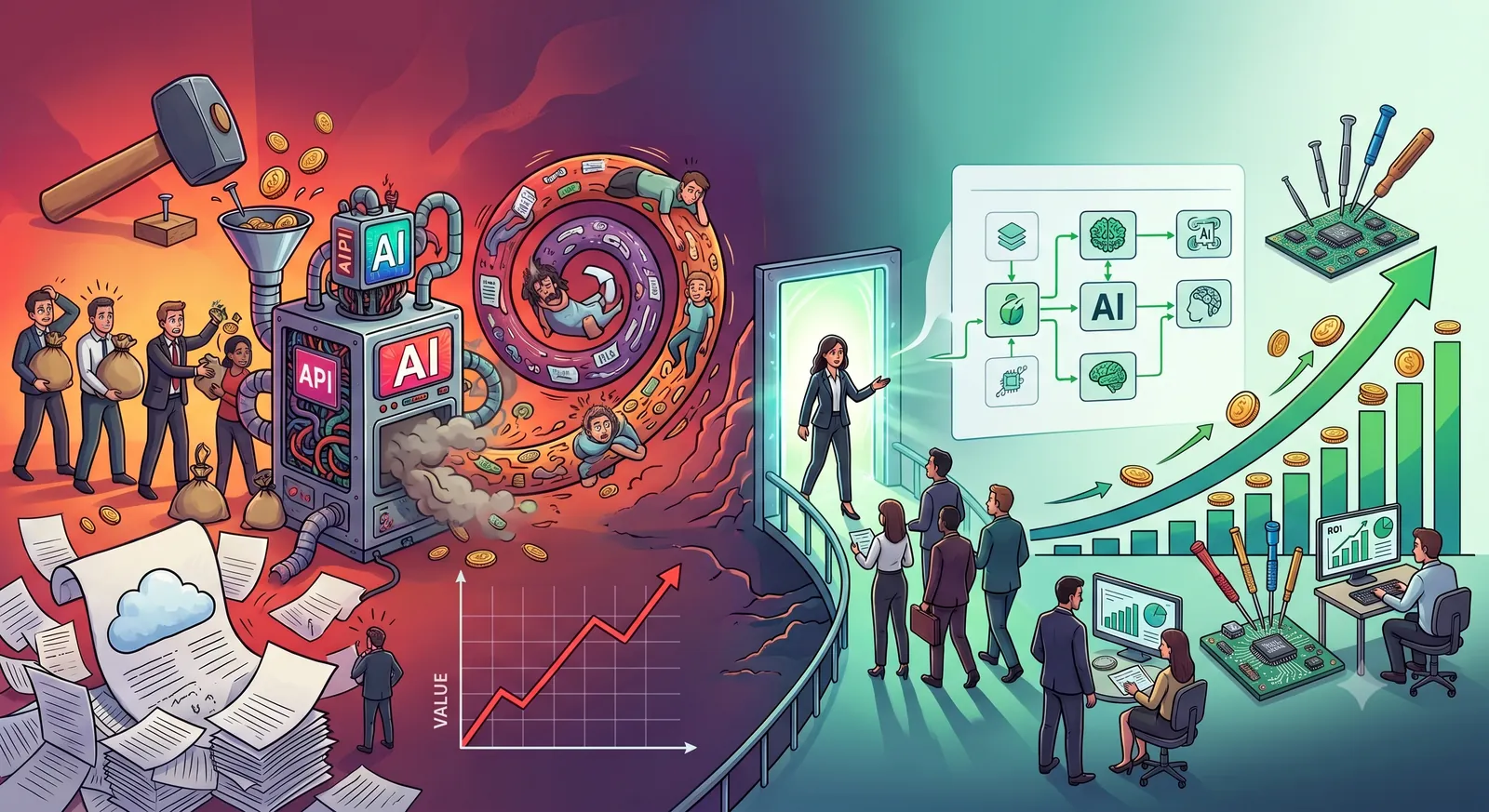
3. Are You Swinging a Sledgehammer at a Thumbtack?
There is no reason to send every trivial request to the biggest, most expensive model in the cloud. It's the equivalent of grabbing a five-kilo sledgehammer to tap in a thumbtack — it works, technically, but it's slow, wasteful, and eventually someone gets hurt (usually your margin).
Proper design combines small, focused models — or even on-device (local) execution where it's feasible — and it cuts your costs through the floor while improving performance and output quality at the same time. This isn't a cost-versus-quality trade-off; done right, it's a win on both axes.
// Match the tool to the task — don't default to the biggest hammer
if (task.isDeterministic) {
return runCode(task) // $0, instant, 100% consistent
} else if (task.complexity === 'low') {
return onDevice(task) // small local model, no per-call fee
} else if (task.complexity === 'medium') {
return routeTo('haiku') // fast, cheap, cloud
} else {
return routeTo('opus') // reserve the sledgehammer for real nails
}
On-device AI is no longer a research curiosity. Small models now run directly on laptops and phones — think Apple Intelligence, Microsoft's Phi family, and Google's Gemini Nano — handling classification, drafting, and extraction with zero marginal cost and zero network round-trip. Every task you keep off the cloud is a task that costs nothing per call and never shows up on the CFO's invoice. We break the full framework down in "The Golden Triangle", where cost, speed, and stability improve together instead of fighting each other.
The Endless Loop: The Other Way "AI-Based" Bleeds You
Runaway token bills are the visible cost. There's a second, quieter one: teams that get stuck in infinite loops of development that never converge on something shippable. The AI writes code that looks right, the AI tests its own code and reports "all green," and everyone celebrates a product that doesn't actually work.
This is where being "AI-based" turns into being "AI-dependent." When the same model that builds the feature also grades it, you get theater instead of engineering — a dynamic we explored in "Your AI Isn't Smart, It's Just Too Polite." Escaping the loop requires human judgment about what "done" means, and an architecture designed to reach it — not just more prompting.
So, What Does It Really Mean?
Being a real AI-based company doesn't mean an LLM sits behind every button. It means you've made a series of deliberate decisions about where intelligence lives, what each unit of it costs, and what you're willing to trade to get it. It means you can look a CFO in the eye and explain your RoTS, your CPST, and your TVM without flinching. And it means you have the discipline to use plain code where plain code wins — because the goal was never to use AI. The goal was to deliver clear, measurable value.
The INUXO Approach
At INUXO, we treat "AI-based" as an engineering commitment, not a marketing badge. We build architectures that integrate AI only where it produces real, measurable value — and use deterministic code, small models, and on-device execution everywhere else. The result is systems that stay economical as they scale, instead of surprising the finance team two quarters in.
A Few Hours Now vs. Months of Frustration Later
Instead of discovering all of this the hard and expensive way, we offer a focused, pinpoint session. It's a few hours of joint work in which we go over your plans together: we sharpen the architecture, make sure it's economically sound, and lay out a work plan that integrates AI only where it genuinely brings real value.
A few hours with us now will save you months of frustration — and, most likely, tens of thousands of dollars down the line.
Thinking about pushing AI deeper into your product — or worried the AI you already shipped is quietly eating your margin? Let's make some order out of the chaos. Book a focused session with INUXO and get a clear read on your architecture, your unit economics, and exactly where AI belongs in your roadmap (and where it doesn't).
Key Takeaways
- "AI-based" is a capability, not a business model: connecting the API is easy; making it economical, reliable, and necessary is the hard part
- Every LLM trades determinism, fixed cost, and predictable latency for probability, variable cost, and tail latency — know what you're signing up for
- Measure RoTS, CPST, and TVM, not vanity user counts — if cost per successful task exceeds the value created, the architecture is broken
- Not every problem needs a model: plain code, simple logic, and classic algorithms are often faster, more accurate, and free per call
- Don't send thumbtacks to the sledgehammer: small models and on-device execution cut cost and improve performance simultaneously
Further Reading & Sources
- MIT Project NANDA: "The State of AI in Business 2025" — the ~95% GenAI pilot failure finding
- Gartner: 30% of GenAI projects will be abandoned after proof of concept by end of 2025
- Liu et al., "Lost in the Middle: How Language Models Use Long Contexts" (Stanford / TACL) — why more context isn't better
- a16z: The Economic Case for Generative AI and Foundation Models
- Apple Machine Learning Research: On-device foundation models
Topics